What’s Really Added to Grocery Store Meat? A Look at Solutions, Water & Preservatives
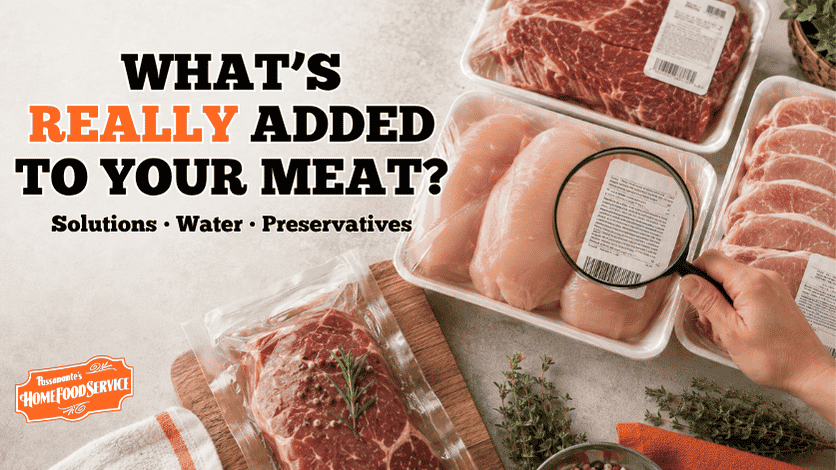
You probably check the ingredient list before buying cereal, salad dressing, or snacks. But when was the last time you checked the ingredient list on a package of raw chicken or pork? It’s easy to assume that a package of chicken breasts contains… chicken breasts. And often, that's exactly what you're getting. But not always. Look closely at some grocery store meat packages and you may find phrases like “contains up to 15% solution,” “enhanced with a solution,” or “contains retained water.” So what does all of that actually mean—and does it matter? Here are a few things worth knowing before your next trip through the meat department.
What Does “Enhanced With a Solution” Mean?
Some raw meat and poultry products are sold with added solutions containing ingredients such as water, salt, flavorings or other approved ingredients.
These solutions may be added through injection, marination, tumbling or other processing methods to increase moisture, improve tenderness or add flavor.
USDA labeling rules require enhanced meat and poultry products to identify the added solution on the package.
You might see wording such as:
“Contains up to 15% of a solution of water, salt…”
That percentage is worth paying attention to.
You're Paying for the Solution, Too
Meat is sold by weight.
If a product contains 15% added solution, some of the weight you're paying for isn't meat—it's the added solution.
That doesn't automatically make the product unsafe or poor quality. But it does mean two packages with the same price per pound aren't necessarily an apples-to-apples comparison.
It's one reason we recommend looking beyond the price sticker when comparing meat.
What Is “Retained Water”?
Here's where things get a little more interesting.
Retained water isn't necessarily the same thing as an added solution.
Poultry must be rapidly chilled during processing for food safety. One traditional method involves chilling the birds in very cold water.
During that process, poultry can absorb some water.
If water remains in the product as a result of processing, the package may disclose it with language such as:
“May contain up to X% retained water.”
That doesn't mean the chicken was injected with water. It can simply be a result of how it was processed and chilled.
There is another way to chill poultry, though.
Why We Choose Air-Chilled Poultry
Instead of being immersed in a cold-water bath, air-chilled poultry is cooled using cold air.
Because the chicken isn't submerged during chilling, it doesn't take on water from that process.
That can also help produce better browning when it's time to cook. Excess surface moisture is the enemy of a good sear—the wetter the surface, the more energy your pan has to spend evaporating water before browning can really begin.
Passanante's offers local, air-chilled poultry, and it's one of the differences we're particularly proud of.
It's a good example of why two packages labeled simply “chicken breast” may not actually be the same product.
What About Preservatives?
This is an area where it's important not to lump every type of meat together.
Plain, fresh steaks, chicken breasts and pork chops don't inherently contain preservatives simply because they're sold at a grocery store.
Processed and cured meats are different.
Bacon, ham, hot dogs, sausage and some deli meats may contain ingredients such as sodium nitrite or sodium nitrate. These curing agents serve legitimate purposes, including helping control harmful bacteria and creating the flavor and characteristic pink color associated with cured meats.
The takeaway isn't that an unfamiliar ingredient is automatically something to fear.
It's much simpler:
Know what's in the food you're buying and why it's there.
Is Redder Beef Fresher Beef?
Here's another grocery-store assumption worth questioning.
When faced with two packages of beef, many of us instinctively reach for the brightest red one.
But brighter red doesn't necessarily mean fresher.
Beef gets much of its color from a protein called myoglobin. Its appearance changes depending on its exposure to oxygen and the type of packaging used.
That's why beef can range from purplish-red to bright cherry red to brownish-red without color alone telling you whether it's fresh or spoiled.
So don't judge a steak solely by which package is the brightest red in the case.
Why Passanante’s Takes a Different Approach
Grocery store meat has to move through a retail system and ultimately spend time waiting in a refrigerated display case for someone to buy it.
Our model is different.
We select premium meats from trusted U.S. farms and suppliers according to our quality standards, including Prime and Top Choice beef, local air-chilled poultry, grain-fed pork and other specialty meats, and wild-caught seafood.
Our meats are sourced to our standards without steroids and hormones.
Products move through our federally inspected USDA facility, where they're individually portioned and bi-vacuum-sealed before being rapidly flash frozen.
Our goal isn't to keep meat looking appealing under grocery-store lights for days.
It's to preserve its quality so it's ready in your freezer whenever you're ready to cook it.
The Next Time You Buy Meat, Flip Over the Package
You don't need to become a food scientist to make a more informed choice.
Just take a few seconds to look beyond the big words on the front.
Is there an ingredient list?
Does the package say “enhanced with a solution”?
Does it disclose retained water?
Is the product you're comparing actually 100% meat, or are you also paying for an added solution?
None of these questions require you to be afraid of your food.
They simply help you understand what you're buying.
At Passanante's Home Food Service, we believe families deserve that kind of transparency. We've been helping families put quality food on the table since 1916, and more than a century later, we're still pretty particular about what makes it onto yours.